Blog: Pond Construction in Aubrey TX: What North Texas Owners Need
Learn how to build a pond on Aubrey acreage in North Texas. Discover soil requirements, timelines, permits, and what to expect during excavation.
Can you build a pond on Aubrey acreage in North Texas?
Yes — Aubrey and the surrounding Denton County land is well-suited for pond construction, but success depends on reading your soil correctly before you dig. The clay-heavy soils common across this part of North Texas actually hold water well once properly compacted. A qualified contractor will evaluate your site's topography, drainage patterns, and soil composition before any excavation begins.
How long does it take to build a pond on a rural North Texas property?
Most residential ponds on Aubrey acreage take two to six weeks from excavation through final grading, depending on pond size, site conditions, and whether additional work — like land clearing or drainage correction — is needed first. Larger stock ponds or ponds with inlet and outlet structures take longer. Planning and permitting can add time, so starting the conversation early in the season pays off.
Do you need a permit to build a pond in Texas?
In most cases, small private ponds on your own land in Texas do not require a state permit as long as the pond doesn't divert a natural watercourse or cross property lines. However, Denton County and local municipalities may have their own requirements. A licensed general contractor who regularly manages permits across Denton County — like J C Boyd Custom Builders — can confirm what applies to your specific parcel before work starts.
If you've been thinking about adding a pond to your Aubrey property, you're not alone. Acreage owners across Denton County and into Cooke and Grayson counties are adding ponds for everything from livestock water sources and irrigation reserves to fishing retreats and natural swimming features. This guide walks through what you actually need to know: how to read your land, what the excavation process looks like, and how to avoid the planning mistakes that turn a straightforward project into a drawn-out headache.
Why Aubrey Acreage Is a Good Candidate for Pond Construction
The land around Aubrey, TX sits in a transitional zone between the blackland prairie and the cross timbers region. That means you'll often find a mix of tight clay soils and sandy loam depending on where exactly your parcel sits. Clay-dominant soil is your friend when building a pond — it holds water without expensive liners in most cases. Sandy or loamy soils may require compaction work or a bentonite clay treatment to seal the pond bottom properly.
Before anything else, a soil percolation test — sometimes called a "perc test" — tells you how quickly water drains through your earth. A contractor experienced in pond construction across North Texas will pull soil samples from your proposed pond area at multiple depths. If the clay content is sufficient, you're in good shape. If not, you'll know upfront what remediation is needed rather than discovering a leaking pond six months after completion.
Topography matters just as much as soil. Ponds built in natural drainages and low-lying areas fill more easily from rainfall and runoff. A slight natural bowl or depression on your property is often the ideal starting point — less excavation, more natural collection. Your contractor should walk the land with you before a single stake goes in the ground.
What Does the Pond Excavation Process Actually Look Like?
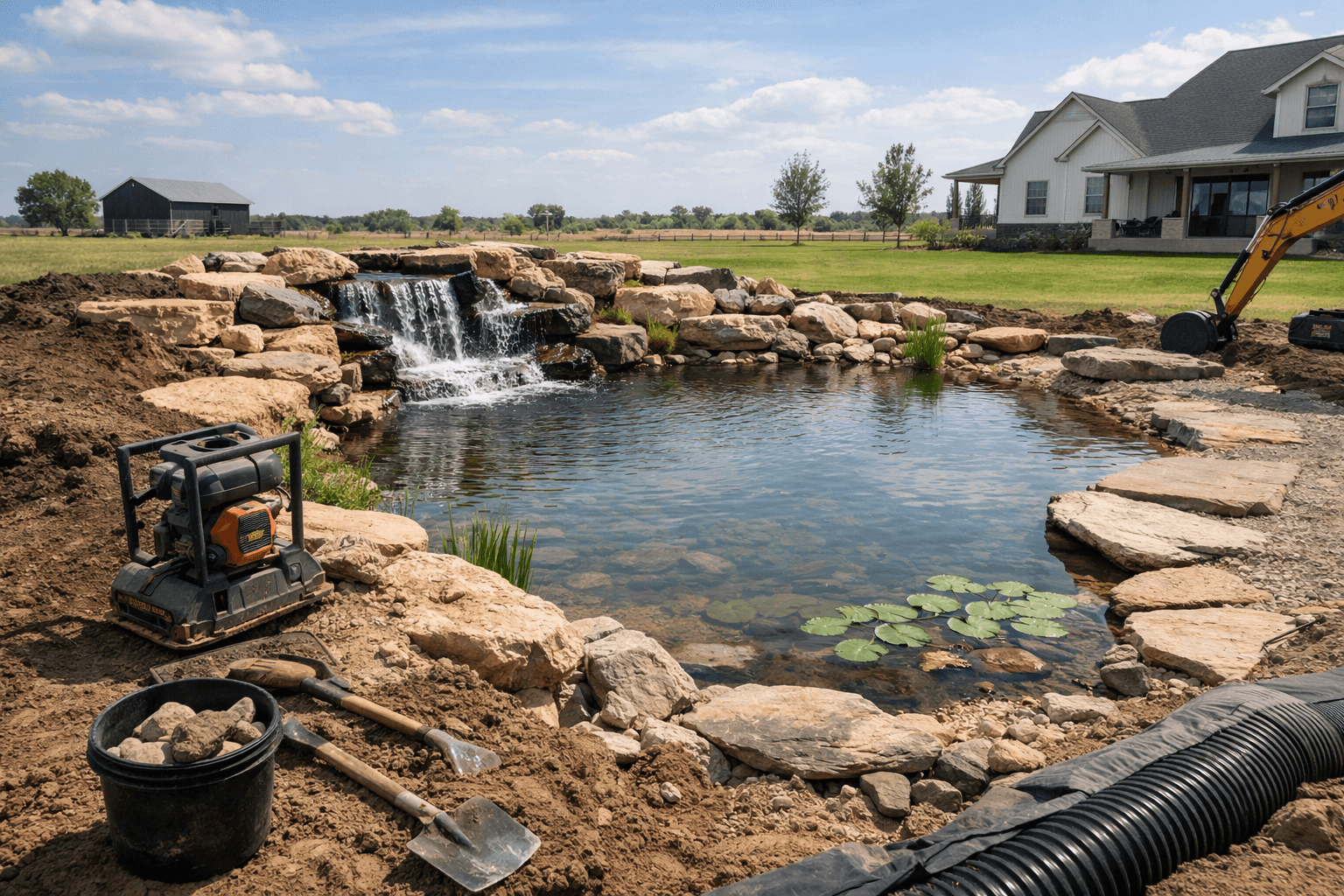
Once the site is selected and soil is evaluated, excavation is the core of the work. Here's how a professional pond build typically unfolds on North Texas acreage:
- Site clearing and access: Trees, brush, and stumps within the pond footprint and equipment access path are removed. On wooded Aubrey parcels, this can be a significant step. J C Boyd Custom Builders handles land clearing and brush removal in-house, so this isn't a separate contractor you have to coordinate.
- Rough excavation: Heavy equipment — typically a track excavator and bulldozer — removes soil to the planned depth. Residential fishing and livestock ponds are commonly dug to eight to twelve feet at their deepest point, with gradual slopes on the entry side for safety and gradual access.
- Shaping and contouring: The pond's edges and bottom are shaped to promote proper water flow, prevent stagnation, and create the desired shoreline profile. Gentle slopes (no steeper than 3:1 on most sides) reduce erosion and make the pond safer.
- Compaction: The pond floor and inside banks are compacted to help the clay particles knit together and seal. This is where the difference between a watertight pond and a leaking one is decided.
- Inlet and outlet structures: A properly built pond needs a way to manage overflow during heavy rain events — especially important in North Texas where a single storm can drop several inches. A principal spillway or overflow pipe protects the dam embankment and prevents washout.
- Final grading and site cleanup: Excess soil is graded away from the pond, banks are seeded or sodded to establish grass cover quickly, and disturbed areas are stabilized to prevent erosion washing sediment into your new pond.
Pond Planning Checklist: Before You Break Ground
- Walk the property with your contractor to identify natural drainage and low spots
- Pull soil samples at multiple depths — confirm clay content before finalizing location
- Determine primary purpose: livestock water, fishing, irrigation, natural swimming, or aesthetic
- Confirm Denton County and local municipality permit requirements
- Plan inlet and outlet structures for North Texas rain events
- Budget for bank stabilization and seeding — bare earth erodes fast
- Coordinate land clearing before excavation if trees or brush are present
If you're also planning a natural swimming feature rather than a utility pond, our guide on Need A Backyard Upgrade Consider A Swimming Pond covers what separates a natural swim pond from a traditional pool build.
Drainage and Erosion: The Details That Protect Your Investment
North Texas weather is not subtle. Aubrey and the surrounding Denton County area can see extended dry stretches followed by heavy, fast rainfall. A pond that isn't engineered for that reality will either lose water through poor sealing or suffer bank erosion from runoff it wasn't designed to handle.
Proper drainage design protects both your pond and the surrounding land. This includes grading the area around the pond so that surface runoff flows toward the pond rather than around it, and installing erosion control measures — fabric, riprap, or vegetation — on slopes where water velocity picks up. A dry creek bed or swale leading to the inlet keeps sediment load low and extends the life of your pond without constant dredging.
If your property has existing drainage problems — standing water, rutted areas after rain, or erosion channels — addressing those at the same time as your pond project often makes the most sense. J C Boyd Custom Builders provides drainage and erosion control as part of a full site preparation approach, so these elements get planned together rather than patched in later.
The USDA Natural Resources Conservation Service (NRCS) EQIP program offers cost-share opportunities for qualifying landowners who build ponds that improve water quality or wildlife habitat — worth asking about during your planning process before breaking ground.
Pond Construction Method: Licensed Contractor vs. Unlicensed Crew
| Factor | Licensed Contractor | Unlicensed Crew |
|---|---|---|
| Soil evaluation | Tested before excavation; informed design | Often skipped; leaking pond discovered after the fact |
| Permit handling | Managed in-house; no compliance gaps | Left to owner; easy to miss requirements |
| Overflow structures | Engineered for North Texas rainfall | Often absent or undersized; bank washout risk |
| Bank stabilization | Seeded and protected before project closes | Often skipped; erosion silts pond within a season |
| Insurance | Liability + workers' comp on every project | Owner absorbs all risk |
- Soil evaluation: tested before excavation vs. skipped and discovered leaking after
- Permits: managed in-house vs. left to the owner
- Overflow structures: engineered for North Texas rain vs. often absent or undersized
- Bank stabilization: included before project closes vs. often skipped
- Insurance: full liability and workers' comp vs. owner absorbs all risk
How a One-Stop Builder Changes the Pond Project Experience
A pond rarely exists in isolation on a North Texas property. Most Aubrey landowners are also thinking about fencing the perimeter, clearing additional brush, adding a barn or equipment storage building, or planning a home on the same parcel. Coordinating those projects with separate contractors — each with their own schedule and handoff points — is where projects stall.
J C Boyd Custom Builders was built from the ground up to handle all of it under one roof. Founder Cody Boyd worked every phase of construction himself before earning his contractor's license, so the team understands how land prep, excavation, building, and finishing work connect. A pond project that also needs land clearing and a perimeter fence doesn't require three separate bids and three separate schedules — it's one conversation.
For properties where fencing is part of the plan — whether for livestock, horses, or property boundaries — J C Boyd is also an authorized Priefert Ponderosa fencing installer. That's not a common credential, and it means your fence is installed to manufacturer standards with the right materials from the start. See What Is Priefert Ponderosa Fence Features Cost And More for a full breakdown of what that system offers.
If your long-term vision includes a custom home on the property, it helps to see how site preparation fits into that larger picture. Our overview of The Custom Home Construction Journey From Planning To Completion walks through how early land decisions — including pond and drainage work — shape everything that comes after.
And if you're trying to get a realistic sense of what a full North Texas acreage build involves, Cost To Build A Custom Home In North Texas breaks down the variables that drive the numbers on projects like yours.
According to the Texas Parks and Wildlife Department, private landowner ponds provide significant habitat and water conservation value across the state — and with proper construction, they hold that value for decades. Starting with a site that's been correctly evaluated and built is what makes the difference between a pond that thrives and one that requires expensive repairs within the first few years.
Frequently Asked Questions
What size pond makes sense for a typical Aubrey acreage property?
For most residential and small ranch parcels in the Aubrey area, ponds ranging from a half-acre to two acres of surface area are common and manageable. Smaller ponds — under a quarter acre — can develop water quality issues in the Texas heat unless they're well-shaded or aerated. Larger ponds require more excavation and more engineered overflow capacity. Your contractor should size the pond to your land's natural watershed, not just your preference on paper.
Does North Texas clay soil always seal a pond without a liner?
Not always. While Denton County and Cooke County soils often contain enough clay to hold water, soil composition varies significantly even within a single parcel. Sandy pockets, decomposed rock layers, or areas where topsoil has been previously disturbed may not seal naturally. A soil test before excavation identifies whether compaction alone is sufficient or whether bentonite treatment is needed. Skipping this step is the most common reason new ponds lose water after construction.
Can a pond be added to a property that's already been built on?
Yes — ponds are added to developed properties regularly, as long as the selected site has adequate drainage, sufficient distance from existing structures and septic systems, and enough undisturbed area to work with. Access for heavy excavation equipment is the most common practical constraint on developed lots. A site visit with your contractor will clarify what's feasible and what adjustments might be needed to the proposed location before any planning commitments are made.
How do you keep a new pond from silting up quickly?
Bank stabilization is the primary defense against early siltation. Seeding or sodding bare banks right after excavation — before the first significant rain — keeps loose soil from washing into the pond. Establishing a vegetated buffer strip around the perimeter also filters surface runoff before it reaches the water. A properly designed inlet structure with a sediment trap further reduces what enters the pond during storms. These aren't optional extras; they're what determines how long your pond stays clean and productive.
Does J C Boyd handle pond projects in areas outside Aubrey?
Yes. J C Boyd Custom Builders serves property owners across Cooke, Denton, and Grayson counties, including Gainesville, Sanger, Pilot Point, Denison, and surrounding communities. Pond construction, excavation, and full site preparation are offered throughout the service area. If your parcel is anywhere in North Texas and you're planning a pond, reach out for a free consultation — the team responds within one business day.
Ready to talk through what a pond on your Aubrey property would actually involve? J C Boyd Custom Builders offers a free consultation with no obligation, and you'll hear back within one business day. Call 940-368-1882 or contact us online to start the conversation. The office is open Monday through Friday, 8 to 5, and Saturday by appointment.
About the Author
J C Boyd Custom Builders, LLC
Serving Gainesville, TX and all of North Texas with custom home building, pool construction, and land clearing services. Licensed, insured, and 5-star rated.
Start Your Project
Ready to build your custom home, pool, or prepare your land? Get a free consultation from J C Boyd Custom Builders.
Contact Us940-368-1882Related Articles
Are You Ready to Start Building?
Explore. Dream. Get Inspired.
Let's build your vision together. Contact J C Boyd Custom Builders for a free consultation serving Gainesville, TX and all of North Texas.
Contact Us